PROTOTYPE · PUGLIA PILOT AREA
Predictable recovery of critical raw materials.
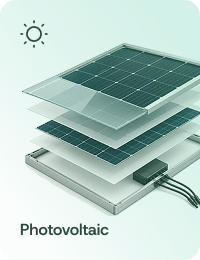
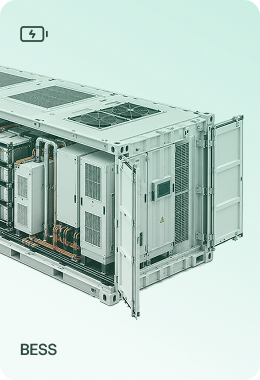
MACTEE (Circular Mapping for the Energy and Ecological Transition) maps, locates and quantifies the recovery potential of critical raw materials in photovoltaic, wind and energy storage (BESS) installations, projecting their availability over time.

PROTOTYPE · PUGLIA PILOT AREA
Predictable recovery of critical raw materials.
MACTEE (Circular Mapping for the Energy and Ecological Transition) maps, locates and quantifies the recovery potential of critical raw materials in photovoltaic, wind and energy storage (BESS) installations, projecting their availability over time.
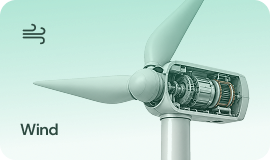
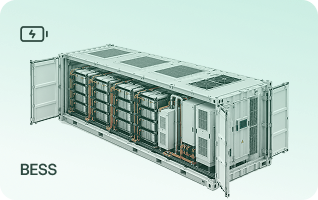
HOW DOES MACTEE WORK?
What the platform does
Planning recovery takes precise answers: where, when, how much. MACTEE brings them together in a single platform.
01
· Map
Locates facilities and the critical materials they contain.
02
· Estimate
Calculates the theoretically and actually recoverable quantities.
03
· Evaluate
Compares recovery costs with the market value of the materials.
04
· Correlate
Integrates the constantly evolving data.
WORK PACKAGE
Research Objectives
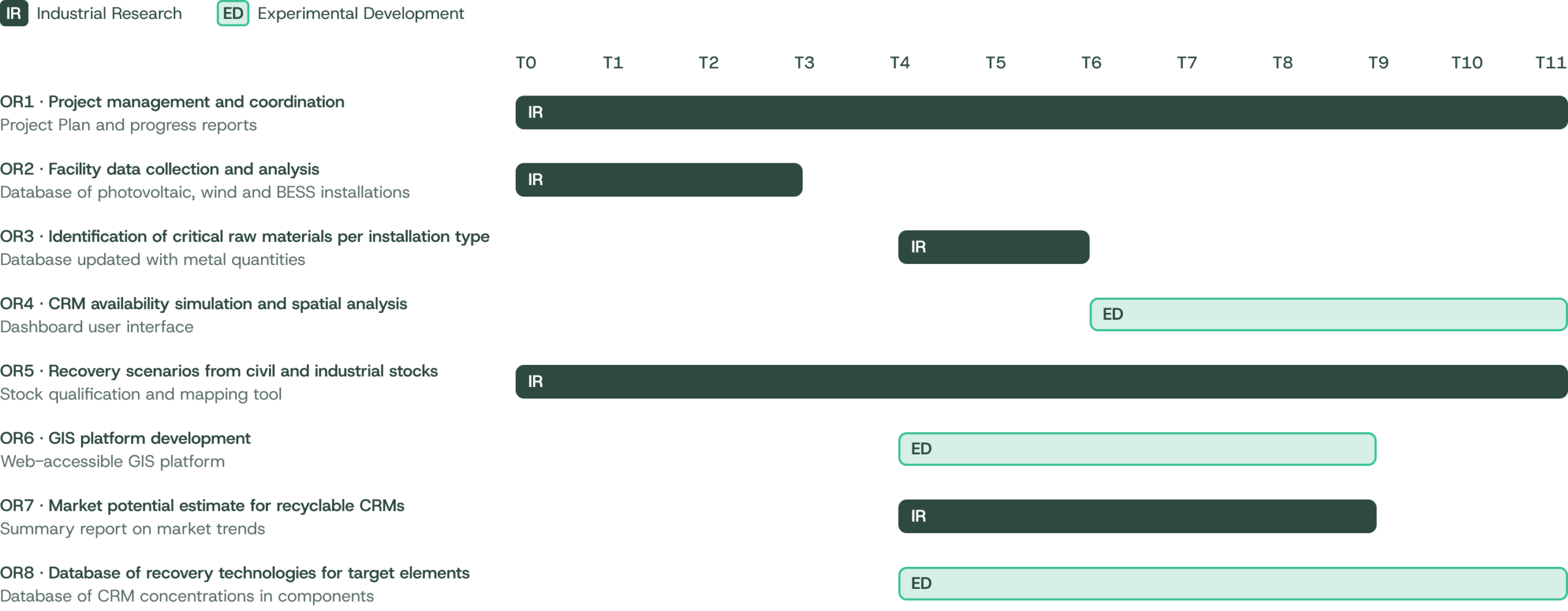
Project activity timeline, T0–T11.
Research Objectives in Detail
OR1
Project management and coordination
Laser Romae
IR
Technical-scientific coordination and project management: continuous monitoring of progress, assessing and deciding on the corrective actions needed to reach the objectives. Laser Romae also manages institutional relations with MASE.
OR2
Facility data collection and analysis
Laser Romae
IR
Acquisition of data on the location, capacity and technology of photovoltaic, wind and BESS facilities in the area of interest — a preliminary activity for the subsequent analyses. The data flows into a relational database with a unique identifier, geographic coordinates, capacity in kW and technology.
OR3
Identification of critical raw materials per facility type
Laser Romae
IR
Qualitative and quantitative assessment of critical and strategic raw materials in the components of wind, photovoltaic and BESS installations. A wind turbine is 86% metal by composition: recovery contributes niobium, copper, manganese, nickel, dysprosium and neodymium, with a correction coefficient for recovery efficiency.
OR4
CRM availability simulation and spatial analysis
Laser Romae
ED
Simulation of critical raw material availability based on facility decommissioning timelines, through an interactive dashboard with filters for technology, region, period (2025–2045) and critical material, with conservative, realistic and optimistic scenarios.
OR5
Recovery scenarios from civil and industrial stocks
CINIGeo
IR
Methodology for qualifying, quantifying and mapping raw materials from civil and industrial stocks: technological networks being decommissioned or abandoned, and buildings, based on their estimated release time. It concerns ferrous metals, aluminium and copper present in these secondary deposits.
OR6
GIS platform development
Laser Romae
ED
GIS platform to map and analyze the territorial distribution of critical raw materials recoverable from end-of-life facilities. It integrates technical and public data, visualizes the progressive decommissioning of facilities, estimates recovery potential and supports national strategic planning.
OR7
Market potential estimate for recyclable CRM
CINIGeo
IR
Quantitative assessment of the economic potential of critical raw materials following the decommissioning of photovoltaic, wind and BESS installations in the pilot areas. Includes an estimate of Italy's contribution to the recycling objectives of the Critical Raw Materials Act.
OR8
Database of recovery technologies for useful materials
CINIGeo
ED
Analysis of recovery processes and a database of available technologies (BAT) for photovoltaic panels, wind turbines, BESS and civil and industrial stocks, based on the concentrations of elements of interest. The data feeds a techno-economic model of costs and treatment stages.
THE TIMELINE
Research Objectives
Project activity timeline, T0–T11.
OR1
Project management and coordination
Laser Romae
IR
Technical-scientific coordination and project management: continuous monitoring of progress, assessing and deciding on the corrective actions needed to reach the objectives. Laser Romae also manages institutional relations with MASE.
OR2
Facility data collection and analysis
Laser Romae
IR
Acquisition of data on the location, capacity and technology of photovoltaic, wind and BESS facilities in the area of interest — a preliminary activity for the subsequent analyses. The data flows into a relational database with a unique identifier, geographic coordinates, capacity in kW and technology.
OR3
Identification of critical raw materials per facility type
Laser Romae
IR
Qualitative and quantitative assessment of critical and strategic raw materials in the components of wind, photovoltaic and BESS installations. A wind turbine is 86% metal by composition: recovery contributes niobium, copper, manganese, nickel, dysprosium and neodymium, with a correction coefficient for recovery efficiency.
OR4
CRM availability simulation and spatial analysis
Laser Romae
ED
Simulation of critical raw material availability based on facility decommissioning timelines, through an interactive dashboard with filters for technology, region, period (2025–2045) and critical material, with conservative, realistic and optimistic scenarios.
OR5
Recovery scenarios from civil and industrial stocks
CINIGeo
IR
Methodology for qualifying, quantifying and mapping raw materials from civil and industrial stocks: technological networks being decommissioned or abandoned, and buildings, based on their estimated release time. It concerns ferrous metals, aluminium and copper present in these secondary deposits.
OR6
GIS platform development
Laser Romae
ED
GIS platform to map and analyze the territorial distribution of critical raw materials recoverable from end-of-life facilities. It integrates technical and public data, visualizes the progressive decommissioning of facilities, estimates recovery potential and supports national strategic planning.
OR7
Market potential estimate for recyclable CRM
CINIGeo
IR
Quantitative assessment of the economic potential of critical raw materials following the decommissioning of photovoltaic, wind and BESS installations in the pilot areas. Includes an estimate of Italy's contribution to the recycling objectives of the Critical Raw Materials Act.
OR8
Database of recovery technologies for useful materials
CINIGeo
ED
Analysis of recovery processes and a database of available technologies (BAT) for photovoltaic panels, wind turbines, BESS and civil and industrial stocks, based on the concentrations of elements of interest. The data feeds a techno-economic model of costs and treatment stages.
A SHARED CHALLENGE
Why now?
The scenario, and Puglia as the pilot project.
CRITICAL RAW MATERIALS ACT · EU TARGETS 2030
10%
EU consumption of strategic raw materials extracted within the Union
40%
annual demand processed within the EU
65%
maximum dependence on a single non-EU country
25%
EU demand covered by recycling
Source: Regulation (EU) 2024/1252 — Critical Raw Materials Act.
THE SCALE OF THE PROBLEM · PHOTOVOLTAIC 2025–2050
140M
non-subsidized photovoltaic panels reaching end of life in Italy by 2050
€762M
estimated total management cost for the 2025–2050
260,000 t/yr
estimated photovoltaic waste in Italy by 2050
Source: REF Ricerche Laboratory, "La gestione del rifiuto fotovoltaico non incentivato in Italia" (2025). At EU level, the JRC estimates 21–35 million tonnes of photovoltaic waste by 2050; end-of-life wind turbines will rise from around 42,500 (2030) to 86,000 (2050).
Source: REF Ricerche Laboratory, "La gestione del rifiuto fotovoltaico non incentivato in Italia" (2025).
PUGLIA · PILOT AREA
3,627 MW
installed photovoltaic capacity · 2nd Italian region
4,639 GWh
energy produced in 2024 · 12.9% of the national total, 1st region
110,307
active photovoltaic installations in the region
33 kW
average installation size · the highest among Italian regions
Source: GSE, Photovoltaic Solar Statistical Report 2024.
COLLABORATION
Laser Romae | CINIGeo
Integrated collaboration between research and innovation.
MACTEE stems from the collaboration between Laser Romae, an innovative SME specialized in the developing advanced digital solutions, and CINIGeo, a research organization with established expertise in georesources engineering. Laser Romae contributes its know-how in digital systems and data processing; CINIGeo its expertise in the analysis and valorization of strategic raw materials. The result is a partnership between diverse areas of expertise, designed to build MACTEE’s digital platform.
INNOVATIVE SME
Laser Romae
Laser Romae is an innovative SME active since 2013 in the ICT sector, with offices in Rome, Milan and Monopoli. It invests about 15% of its turnover each year in R&D on Artificial Intelligence, Circular Economy and indoor/outdoor positioning. Within MACTEE, it contributes its know-how in process digitalization, data processing and integration, Artificial Intelligence and the design of advanced technology platforms.
RESEARCH OBJECTIVES
OR1
OR2
OR3
OR4
OR6
RESEARCH ORGANIZATION
CINIGeo
CINIGeo (Italian National Interuniversity Consortium for Georesources Engineering) is a research organization founded in 1988, active in promoting and coordinating scientific activities in the field of georesources. Within MACTEE, it contributes scientific, methodological and specialist expertise in the analysis, qualification, quantification and mapping of critical and strategic raw materials.
RESEARCH OBJECTIVES
OR5
OR7
OR8
CONTACT US
Let's plan the recovery together
Fill in the form to receive more information about MACTEE and the platform, or to propose a partnership.
Fields marked with * are required.
INSIGHTS AND RESOURCES
Want to know more?
The regulatory scenario, prototype in Puglia, the platform's four functions, and the collaboration between Laser Romae and CINIGeo.
Finanziamento: PNRR – Missione 7 REPowerEU
Investimento: 8 – Approvvigionamento sostenibile, circolare e sicuro delle materie prime critiche
Avviso: Pubblico del Ministero dell’Ambiente e della Sicurezza Energetica (MASE) per attività di ricerca e sviluppo
CUP: F89J25001470009